Reasons for Leaving a Job: How to Answer 'Why Did You Leave?'
Good reasons for leaving a job, how to answer 'Why did you leave your last job?' in an interview, and sample answers for being laid off, fired or quitting.

“Why did you leave your last job?” sounds like a simple question, but it’s one of the few in an interview where a weak answer can undo a good one. The interviewer isn’t just collecting facts. They’re listening for whether you left for a reason that could repeat here, and whether you’ll talk about them the same way someday.
The good news: almost any honest reason for leaving a job can be explained well. Here’s how to answer, which reasons work best, and sample answers for the situations people worry about most, from being laid off to being fired.
What the interviewer is really asking
Behind the question are three quieter ones:
- Is there a problem I should know about? A pattern of conflict, poor performance, or leaving when things get hard.
- Will the same thing happen here? If you left because of long hours and this job has long hours, that matters.
- How do you talk about people? Your tone about a former employer is a preview of how you’ll talk about this one.
A good answer handles all three without making a speech about any of them.
How to answer “Why did you leave your last job?”
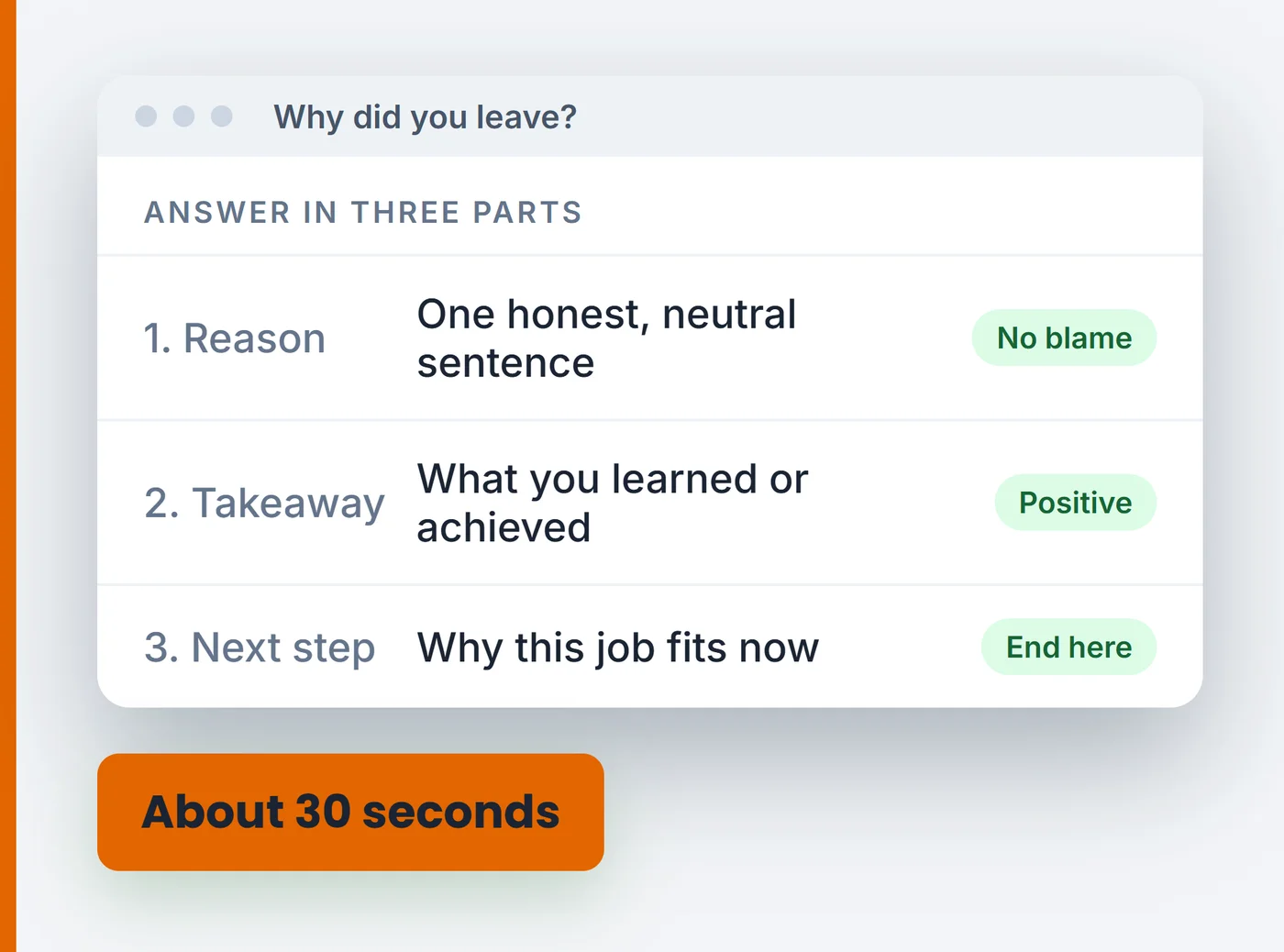
Keep it to three parts and about 30 seconds:
- The reason, in one honest sentence. Neutral and factual, no blame.
- What you took from the job. A skill, a result, or something you learned, so the past role sounds like a positive.
- Why this job is the next step. Turn the answer toward what you want now and how this role fits.
The third part matters most. You want the conversation to end on where you’re going, not on what went wrong.
Good reasons for leaving a job
These reasons are common, easy for an interviewer to understand, and rarely raise concerns when explained briefly:
- You want to grow, with more responsibility or a role that isn’t available where you are.
- You’re changing careers or moving into a different kind of work.
- The company changed: a reorganization, new ownership, a shift in direction, or a role that changed into something different.
- You were laid off because of budget cuts, restructuring or closure.
- You relocated, or want to work closer to home or remotely.
- You want a better fit: a different company size, industry, schedule or culture.
- Family, health or caregiving needed your time, and you’re ready to return.
- You went back to school or took time for training.
- Pay or benefits didn’t keep up, as long as it isn’t the only thing you mention.
Sample answers for common situations
You’re still employed (“Why are you leaving your current job?”):
I’ve learned a lot in four years at [Company], especially running our customer onboarding from start to finish. There isn’t room to move into a team lead role there right now, and that’s the next step I’m looking for. This role combines leading a small team with the onboarding work I already know well.
You were laid off:
My role was one of several eliminated when the company restructured in [month]. Before that I spent three years building our reporting process, and I’m proud of how it helped the team plan. I’m looking for a role where I can do that kind of work again, which is a big part of why this position stood out.
Layoffs are common and rarely held against anyone. Say it plainly and move on to what you did and what you want.
You were fired:
I was let go from my last role. Honestly, it wasn’t the right fit: the job had shifted toward heavy sales targets, which isn’t where my strengths are. I learned a lot from it, including how much I do my best work on the operations side, which is exactly what this role focuses on.
Don’t lie about being fired. Employers may confirm your dates and the circumstances, and a false answer is a bigger problem than the firing itself. Give a short, honest explanation, show what you learned, and move forward. If it was about performance, name one concrete thing you’ve done to improve since.
You quit without another job lined up:
I left to take time to figure out my next direction, and I used it to complete a project management certification. I’m now focused on project coordinator roles, and this one fits the experience I’ve built.
You left after a short time:
The role turned out to be quite different from what was described. It was almost entirely data entry rather than the analysis work I’d been hired for. I decided it was better to move on quickly than stay in the wrong job, and I’m being more careful now to make sure the role matches what I’m looking for, which is why I asked earlier about the day-to-day work.
You’re changing careers:
After six years in teaching, I realized the part I enjoyed most was designing lessons, not delivering them. I’ve completed coursework in instructional design and built several sample courses. This role is the move I’ve been working toward.
You left a difficult manager or workplace. Keep it about the work, not the people:
My last role had very little structure: priorities changed week to week, and there wasn’t much feedback. I got good at organizing my own work in that setting, but I do my best work with clear goals and regular check-ins. From what you’ve told me about how this team plans its quarters, that’s a much better match.
For more on how hiring managers judge answers like this, see why do you want this job?
What not to say
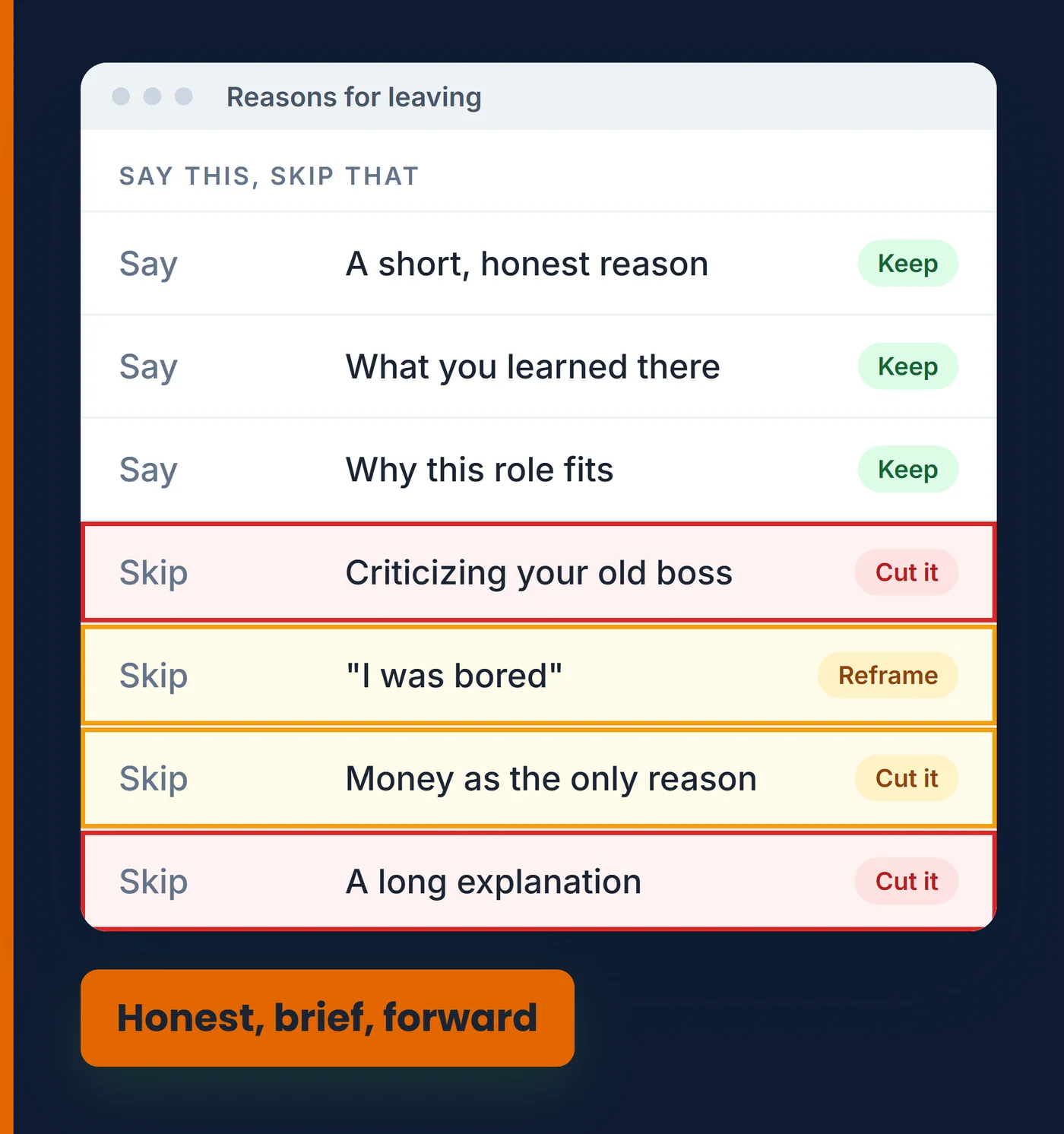
- Criticism of your boss, coworkers or company. Even if it’s true, it makes the interviewer wonder what you’ll say about them.
- “I was bored” or “I hated it.” Reframe as wanting more challenge or a better fit.
- Money as the only reason. Pay is a fair factor, but on its own it suggests you’ll leave for the next raise.
- Long explanations. The longer you talk about why you left, the bigger the problem sounds.
- Anything that contradicts your application or references. Keep your story the same everywhere.
Reason for leaving on a job application
Many applications ask for a reason for leaving each past job in a short text box. Keep it to a few neutral words, and make sure it matches what you’ll say in the interview:
- Career growth
- Position eliminated (or Laid off: restructuring)
- Company closed
- Relocated
- Contract ended
- Returned to school
- Career change
- Family responsibilities
- Seeking a role better aligned with my skills
If you were fired, many people write “Terminated” or “Let go” and are ready to explain briefly in the interview. Whatever you write, it should be true and consistent with your references.
Practice your answer
Write your answer out, then say it aloud until it takes about 30 seconds and sounds natural, not rehearsed. It’s one of the common questions worth preparing ahead of time, along with the others in our guide on how to ace an interview. If a gap in your work history is part of the story, the same approach applies: a short, honest reason, what you did with the time, and why you’re ready now.