How to Ask Someone to Be a Reference (With Email Samples)
How to ask someone to be a reference: who to pick, when to ask, a reference request email template, and samples for a manager, colleague or professor.

A reference call is often one of the last steps before an offer, and it’s one of the few parts of the process you can prepare for completely. The people you choose, and how well they know what to say, can confirm a hiring manager’s good impression or raise a doubt at the worst moment.
Knowing how to ask someone to be a reference comes down to three things: pick people who know your work, ask before you list them, and give them what they need to talk about you well. Here’s how to do each, with a reference request email template and samples for the people you’re most likely to ask.
Who to ask
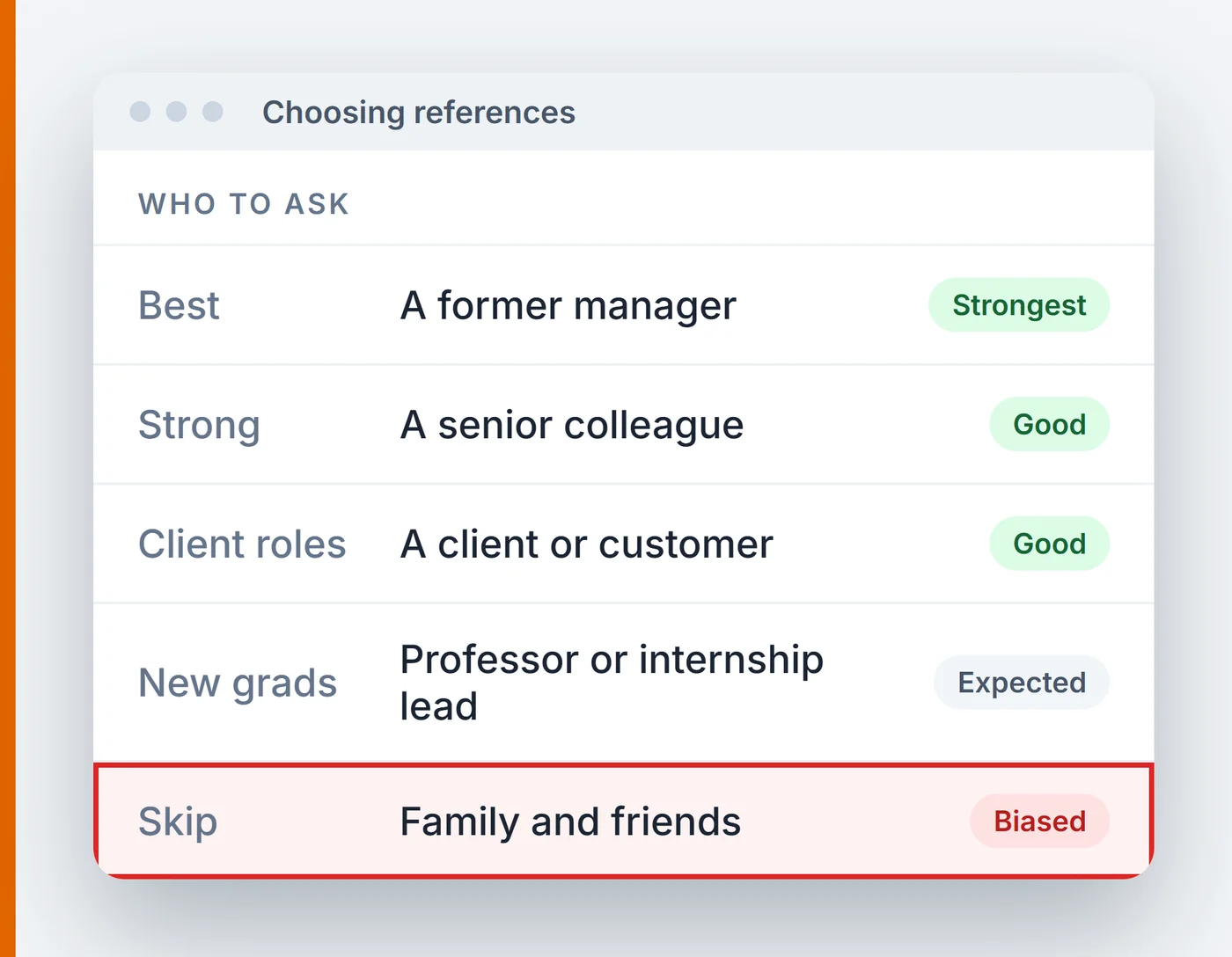
The best references have seen your work up close and can describe it specifically. In rough order of how much weight they carry:
- A former manager. They can speak to your results, reliability and growth. One or two managers make a strong core for any reference list.
- A senior colleague or team lead. Someone who worked alongside you on real projects can describe how you collaborate and solve problems.
- A client or customer. Useful if the job is client-facing, because they can describe you from the other side of the relationship.
- A direct report. For management roles, someone you led can speak to how you manage.
- A professor, internship supervisor or volunteer coordinator. For students and recent graduates with a short work history, these are normal and expected.
Skip family and friends, even if they’ve worked with you. Their opinion is assumed to be biased, so it doesn’t help.
Choose people who will speak about you with real enthusiasm. A lukewarm reference can do more harm than having one fewer name on the list. And match references to the job where you can: for a leadership role, put the manager who saw you lead first.
When to ask
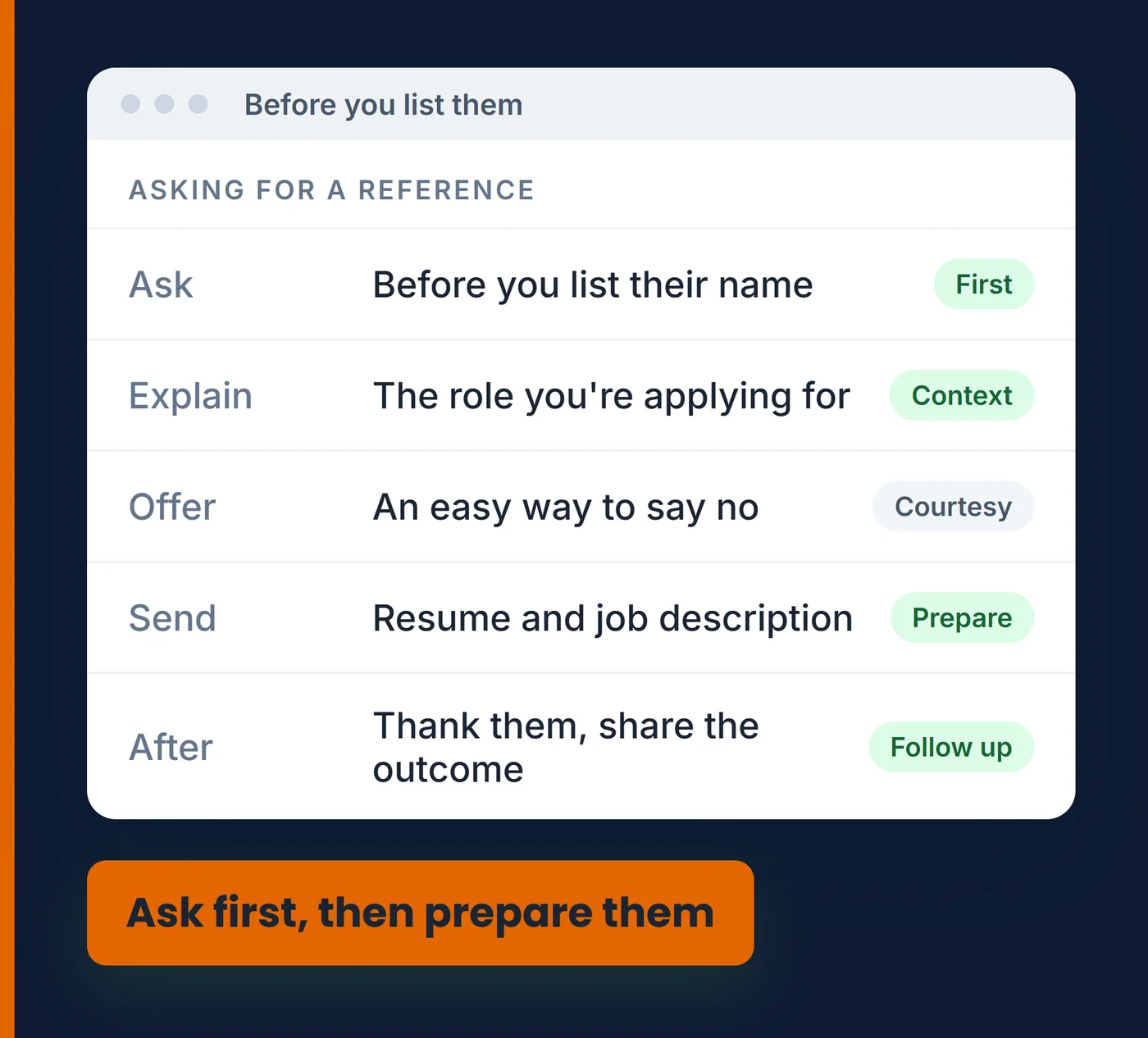
Ask before you list anyone. Nobody wants a surprise call from a recruiter about someone they haven’t spoken to in two years, and a caught-off-guard reference rarely sounds convincing.
The easiest time is when you start an active job search: line up three or four people so you’re ready when an employer asks. Then, when a specific company says it will be checking references, send each person a short heads-up with the role and the company’s name, so they know a call is coming.
If you’re still employed, don’t list your current manager unless you’re comfortable with them knowing you’re looking. Most employers understand this. You can tell them your current employer can be contacted once there’s an offer.
How to ask for a reference
Email is the usual way to ask, because it gives the person time to think and an easy way to say no. For someone you’re close to, a call or a quick conversation is fine, followed by an email with the details.
Whichever way you ask, include:
- What you’re asking. Be direct: “Would you be willing to be a reference for me?”
- The kind of role. A sentence on the job or jobs you’re applying for.
- A reminder of your work together. Especially if it’s been a while.
- An easy way to decline. It makes yes more genuine.
- An offer to send details. Your resume and the job description.
Reference request email template
Subject: Would you be a reference for me?
Hi [Name],
I hope you’re doing well. I’m applying for [type of role, for example operations manager roles], and I’d be grateful if you’d be willing to serve as a reference for me.
I really valued working with you at [company], especially on [a project or responsibility]. I think you’d be able to speak well to my [one or two strengths relevant to the role].
If you’re comfortable with it, I’ll send my updated resume and details about the role, and I’ll let you know before anyone reaches out. And if now isn’t a good time, I completely understand.
Thank you, [Your name] | [phone number]
Reference request samples for different people
A former manager you’ve kept in touch with.
Hi [Name], I’m starting to look for my next role, mostly [type of role]. You saw more of my work at [company] than anyone, so I’d love to list you as a reference if you’re willing. I can send my resume and the roles I’m applying for so you know what to expect.
A colleague.
Hi [Name], I’m applying for [job title] roles and would really appreciate it if you’d be a reference. We worked closely on [project], and you’d be able to speak to how I handled [responsibility]. No pressure at all if it’s not a good time.
A professor or internship supervisor (useful for students and recent graduates).
Dear Professor [Name], I took your [course] in [semester] and worked on [project or paper]. I’m now applying for entry-level [field] positions, and I’d be grateful if you’d be willing to serve as a reference. I’m happy to send my resume and a summary of the work I did in your class to help.
Someone you haven’t talked to in a while. Reconnect before you ask, and remind them of specifics.
Hi [Name], it’s been a while since we worked together at [company]. I hope things are going well with [something you know about them]. I’m applying for [type of role] and wondered whether you’d be willing to be a reference. I’ve attached my resume to refresh your memory on what I’ve been doing since, and I’d be glad to catch up by phone first if that’s easier.
Prepare your references
Once someone says yes, make it easy for them to help you:
- Send your resume and the job description, or a short summary of the roles you’re targeting.
- Suggest two or three points they could speak to: a project you led, a problem you solved, a skill the job calls for. You’re not scripting them, just jogging their memory.
- Confirm their details: current title, company, the phone number and email they’d prefer, and how you know each other.
- Tell them when a call is likely, and from which company.
When an employer asks, give them a simple reference list with each person’s name, title, company, phone, email, and a few words on how you know them (for example “my manager at [company], 2022 to 2025”).
Worried about a bad reference?
People often worry about what a former employer might say. Many companies have a policy of confirming only your job title and dates of employment, but practices vary, so don’t count on that alone.
The best protection is control over who you list. Only name people you’ve asked directly and who answered with a clear, warm yes. If someone hesitates or offers to be a reference “if you can’t find anyone else,” thank them and choose someone else. If you’re unsure what a past employer will say, a colleague who left the same company can sometimes give a more accurate picture than the HR department.
Say thank you and keep them posted
Thank each reference as soon as you know they’ve been contacted, and tell them how it turned out, whether you got the job or not. A short note is enough. If they helped you land an offer, a handwritten card is a nice touch.
Your references are part of your network, so keep in touch between job searches, not just when you need something. Our guide on how to network for a job covers how to do that without it feeling forced. And for the rest of the late-stage process, see how to follow up after an interview.