How to Follow Up After an Interview (With Email Samples)
When to send a follow-up email after an interview, what to write, and samples for checking in, getting no response, and when you have another offer.

The interview went well, they said you’d hear back soon, and now it’s quiet. Knowing how to follow up after an interview is mostly about timing: one well-placed email shows interest, while a stream of them makes a hiring manager hesitate.
Here’s when to send each follow-up email after an interview, what to put in it, and samples you can adapt, from the first check-in to the email you send when you still haven’t heard anything.
The follow-up timeline
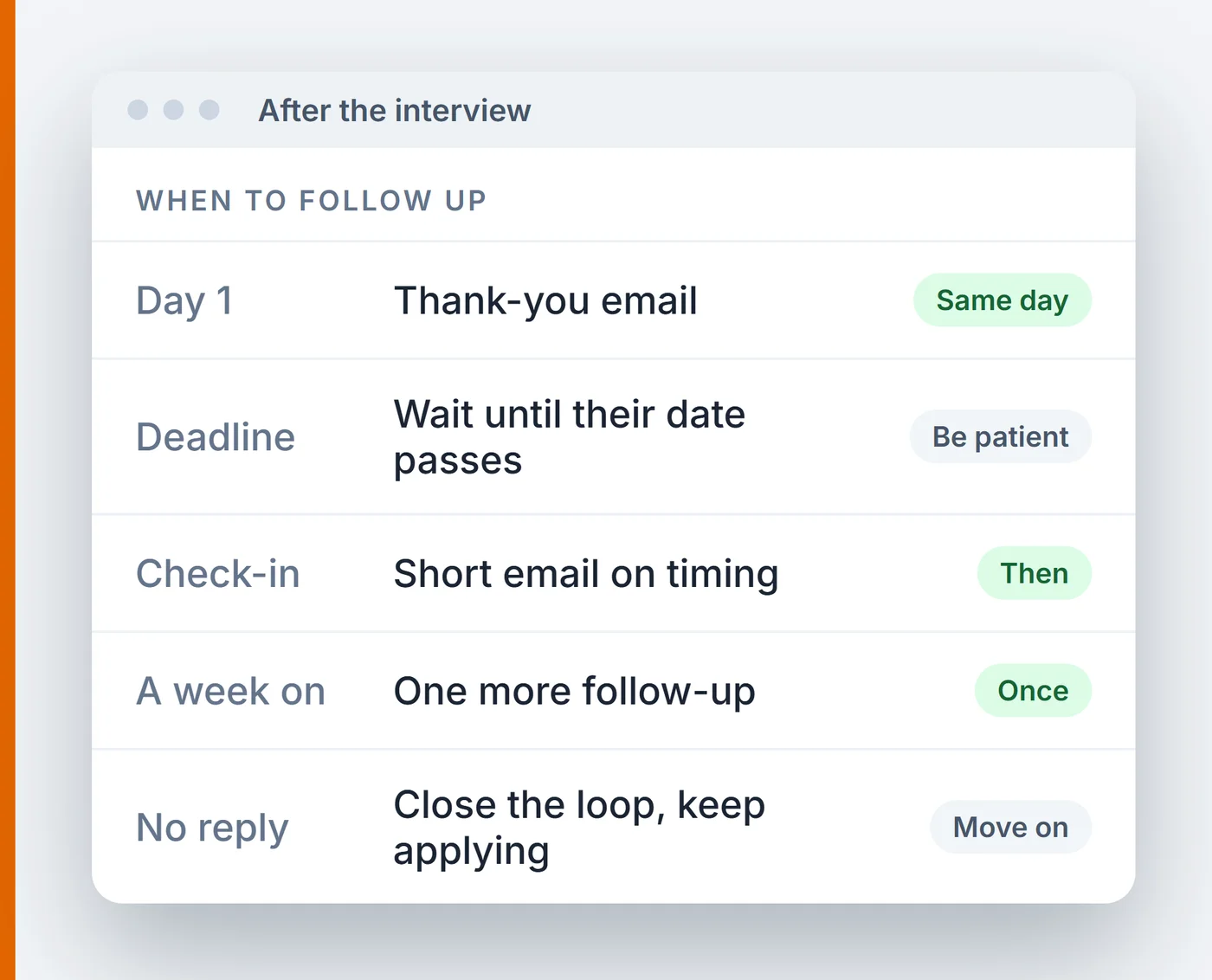
Most interview follow-ups fit into the same sequence:
- Same day or next day: a thank-you email to each interviewer.
- When their decision date passes: a short check-in.
- About a week after that: one more follow-up if you still haven’t heard.
- After that: a final, polite note that closes the loop, then move on.
The most useful thing you can do happens before you leave the interview: ask when they expect to make a decision and what the next step is. That answer sets your timeline. If they say “by the end of next week,” you know when a check-in is reasonable. If you didn’t ask, it’s fair to wait about a week before your first check-in.
Step 1: Send a thank-you email
The first follow-up is the thank-you note, sent the same day or the next morning. Keep it short, mention something specific from the conversation, and restate why you’d be a good fit. Our guide on how to ace an interview has a full sample thank-you email you can adapt.
The thank-you isn’t the place to ask about timing. Its job is to leave a good last impression. The check-in comes later.
Step 2: The follow-up email after an interview
When the date they gave you has passed, wait one or two business days, then send a brief check-in. Reply in the same thread as your thank-you or the last message you received, so they have the context in front of them.
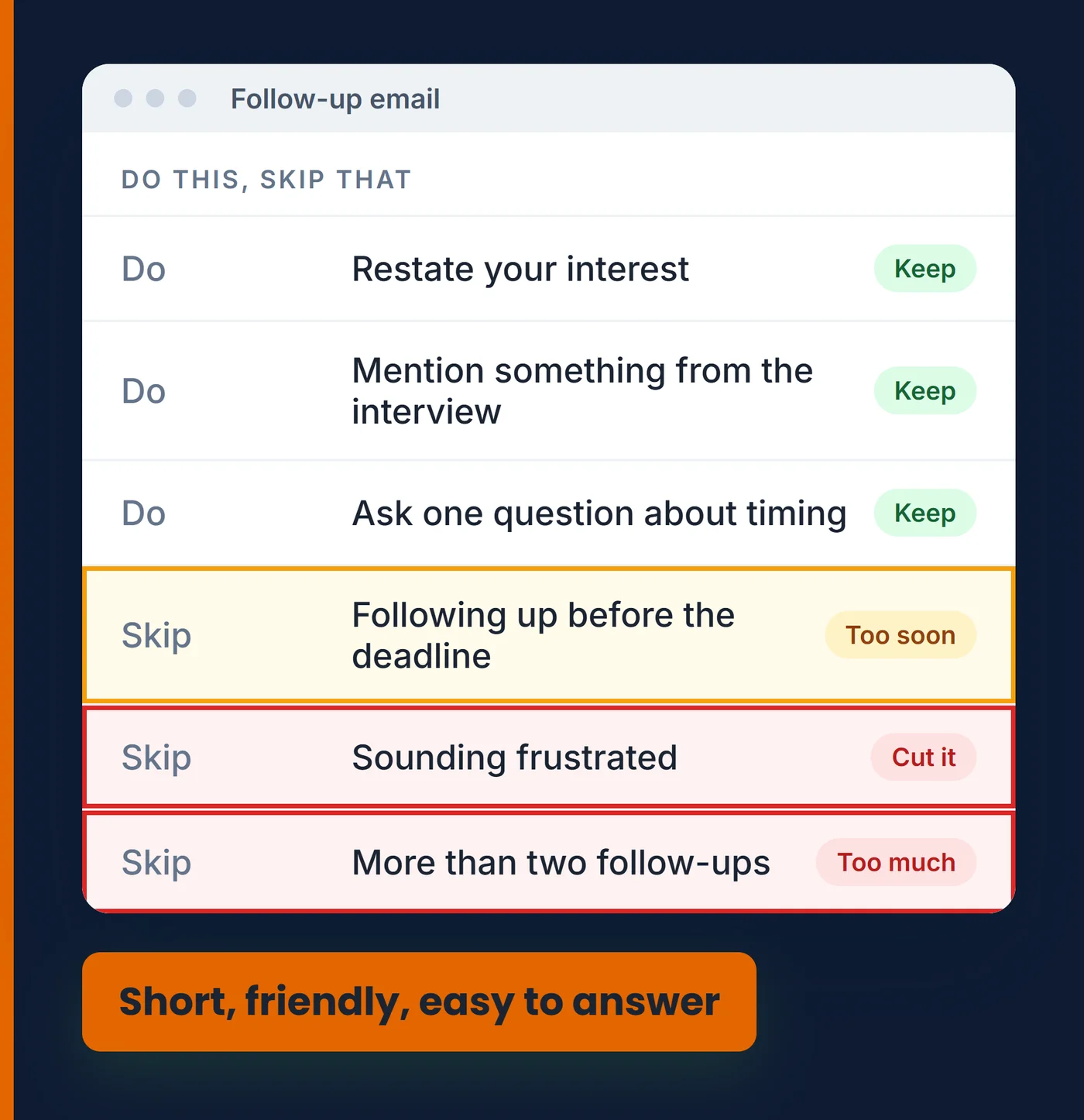
A good follow-up email after an interview does three things: reminds them who you are, restates your interest, and asks a simple question about timing.
Subject: Following up on the [job title] interview
Hi [Name],
I hope your week is going well. I wanted to follow up on my interview for the [job title] role on [day]. I enjoyed our conversation about [a topic from the interview], and I’m still very interested in joining the team.
Do you have an update on the timeline for a decision? Please let me know if there’s anything else I can send you in the meantime.
Best, [Your name]
That’s enough. You don’t need to resell yourself or repeat your qualifications. The goal is to stay visible and make it easy for them to reply.
Step 3: Follow-up email after an interview with no response
If a week passes after your check-in with no reply, one more email is reasonable. Hiring often stalls for reasons that have nothing to do with you: a manager on leave, a budget review, a role being redefined. Keep the tone light and give them an easy way to answer.
Subject: Re: Following up on the [job title] interview
Hi [Name],
I’m following up on my note from last week about the [job title] role. I know hiring timelines can shift, so I wanted to check whether there’s any news, or whether I should expect to hear back at a later date.
I’m still very interested and happy to provide anything else you need.
Thanks, [Your name]
If the hiring manager hasn’t answered, it can help to send this one to the recruiter or HR contact instead, since they often handle candidate updates.
Step 4: Close the loop
After two follow-ups with no reply, stop chasing. Send one last short note that closes the loop politely, then put your energy into other applications.
Hi [Name],
I haven’t heard back about the [job title] role, so I’ll assume you’ve moved forward with other candidates. Thank you again for the time you and the team spent with me. If anything changes or a similar role opens up, I’d be glad to talk.
Best, [Your name]
This email sometimes gets a reply when the others didn’t, because it’s easy to answer and it removes any pressure. Either way, you’ve finished on a professional note.
Follow-up samples for special situations
You have another offer. If another company has made you an offer but you’d prefer this role, it’s fair to tell them. Be honest and specific about your deadline, and never invent an offer to speed things up.
Hi [Name],
I wanted to let you know that I’ve received an offer from another company and need to respond by [date]. The [job title] role at [Company] is still my first choice, so I wanted to check whether you’re able to share an update on your timeline before then.
Thank you, [Your name]
After a final-round interview. When you’ve met several people, send your check-in to the person who’s been coordinating the process, usually the recruiter or the hiring manager. One email to them is better than separate notes to everyone you met.
When they gave you a decision date. Wait until that date has passed, plus a business day or two, before checking in. A follow-up before the date they gave you suggests you weren’t listening.
By phone. Email is usually best because it’s easy to answer on their schedule. If the recruiter has been calling you throughout the process, a short call is fine too. Keep it to a minute: who you are, the role, and a question about timing.
Follow-up mistakes to avoid
- Following up too soon. A check-in two days after the interview, before any deadline has passed, reads as impatience.
- Following up too often. Two follow-ups after the thank-you, and then a closing note, is the limit. More than that hurts your chances.
- Sounding frustrated. “I’ve been waiting two weeks” puts them on the defensive. Keep every message friendly, even if you’re annoyed.
- Switching channels to get attention. Messaging the hiring manager on LinkedIn, by phone and by email in the same week feels like pressure.
- Pausing your search. Keep applying while you wait. Nothing is certain until you have an offer in writing.
If the answer is no
Sometimes the follow-up brings a rejection. That’s still a better outcome than silence, because now you can reply well and move on. Our guide on how to respond to a job rejection email has sample replies and a short way to ask for feedback.
And if the answer is yes, but the offer isn’t quite right, see how to counter offer a job before you accept.