Job Offer Acceptance Email: How to Accept an Offer (Samples)
How to accept a job offer: what to check first, what to confirm in your acceptance email, and samples for a simple yes, negotiated terms and a phone call.

You got the offer, and you want it. Before you reply “Yes!”, take an hour to do it properly. Your job offer acceptance email is the first thing you write as a future employee, and it’s also your written record of what you agreed to: the title, the pay, the start date.
Here’s how to accept a job offer the right way, what to check before you say yes, what to confirm in the email, and accepting job offer email samples you can adapt.
Before you accept
Get the offer in writing. A verbal offer is good news, but accept once you’ve seen the written version: the offer letter or an email with the full terms. That’s the document you’ll check everything against.
Read the whole package. Look past the salary to the title, start date, bonus, benefits, paid time off, remote or hybrid policy, and any conditions such as a background check or references. Ask about anything unclear now, while it’s easy to fix.
Negotiate first, if you’re going to. Once you’ve accepted, the conversation about terms is over. If something would change your answer or make the offer a better fit, raise it before you say yes. Our guide on how to counter offer a job has scripts for that conversation.
Reply within the deadline. If they gave you a date, answer before it. If they didn’t, a day or two is a reasonable time to review before you respond.
How to accept a job offer
Many offers come by phone first. It’s fine to say how pleased you are on the call and that you’re planning to accept, then send your formal acceptance by email once you have the written offer. Email is where the details get confirmed.
A good acceptance email does five things:
- Thanks them for the offer and the opportunity.
- Accepts clearly, with the words “I’m pleased to accept.”
- Confirms the key terms: job title, salary, start date, and anything else you agreed.
- Asks about next steps: paperwork, onboarding, what happens on day one.
- Sounds like you’re glad to be joining, because the email will probably be shared with your new manager.
Keep it short. You’re confirming, not negotiating, so a few paragraphs is plenty.
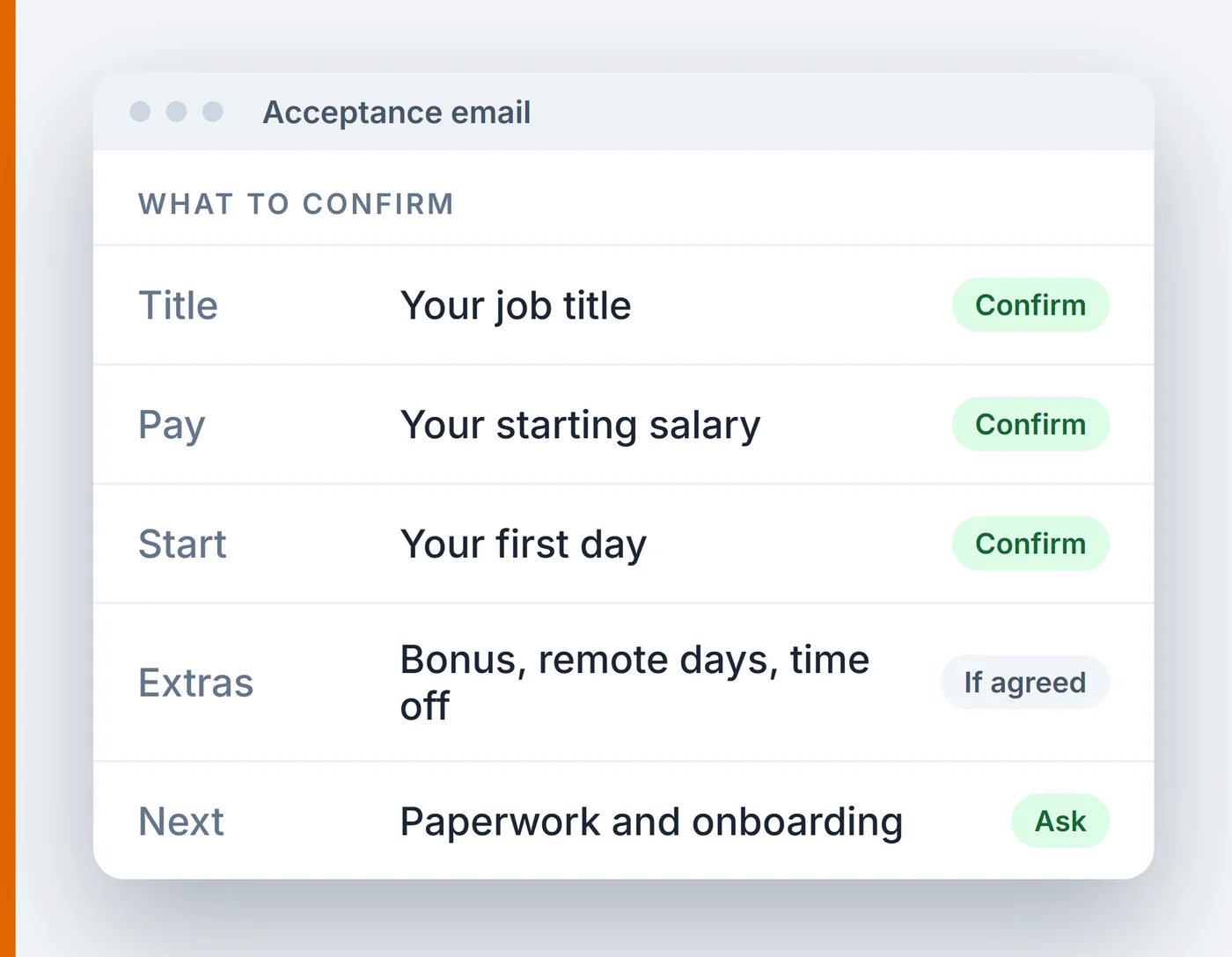
Job offer acceptance email template
Subject: Job offer acceptance: [your name], [job title]
Hi [Name],
Thank you so much for offering me the position of [job title] at [Company]. I’m pleased to formally accept the offer, and I’m excited to join the team.
As discussed, I understand my starting salary will be [$X] per year, and my start date will be [date]. [Add any other agreed terms, such as a signing bonus or remote schedule.]
Please let me know if there’s any paperwork you need from me before my first day, or anything I should prepare. I’m looking forward to getting started.
Best regards, [Your name] | [phone number]
Reply in the same thread as the written offer, so everything is in one place. If the offer letter needs a signature, sign and return it as well. The email doesn’t replace it.
Accepting job offer email samples
A simple acceptance. For an offer you’re happy with as it stands:
Hi [Name],
Thank you for the offer for the [job title] role. I’m happy to accept, and I’ve signed and attached the offer letter. I’m confirming a start date of [date] at the salary of [$X] outlined in the letter.
I’m looking forward to working with you and the team. Please let me know what you need from me before then.
Best, [Your name]
After negotiating. When terms changed in conversation, confirm every one in writing and ask for an updated letter.
Hi [Name],
Thank you for working with me on the offer. I’m delighted to accept the [job title] position. To confirm what we agreed on our call: a base salary of [$X], a signing bonus of [$Y], and a start date of [date], with [two remote days a week].
Could you send an updated offer letter with these terms? I’ll sign and return it as soon as I receive it. I’m excited to get started.
Best, [Your name]
After accepting by phone. A short follow-up that puts the call in writing:
Hi [Name],
Thank you again for calling today. As I said on the phone, I’m very happy to accept the offer for the [job title] role. I’m confirming a start date of [date] and a salary of [$X]. I’ll watch for the offer letter and onboarding paperwork.
Best, [Your name]
With a question. If you have one small open item, it’s fine to accept and ask in the same email, as long as it’s a question and not a new negotiation.
Hi [Name],
I’m pleased to accept the offer for the [job title] role, with a start date of [date] and a salary of [$X]. One quick question: will the laptop and equipment be shipped to me before my first day, or should I plan to pick them up in the office?
Thank you again. I’m looking forward to joining the team.
Best, [Your name]
After you accept
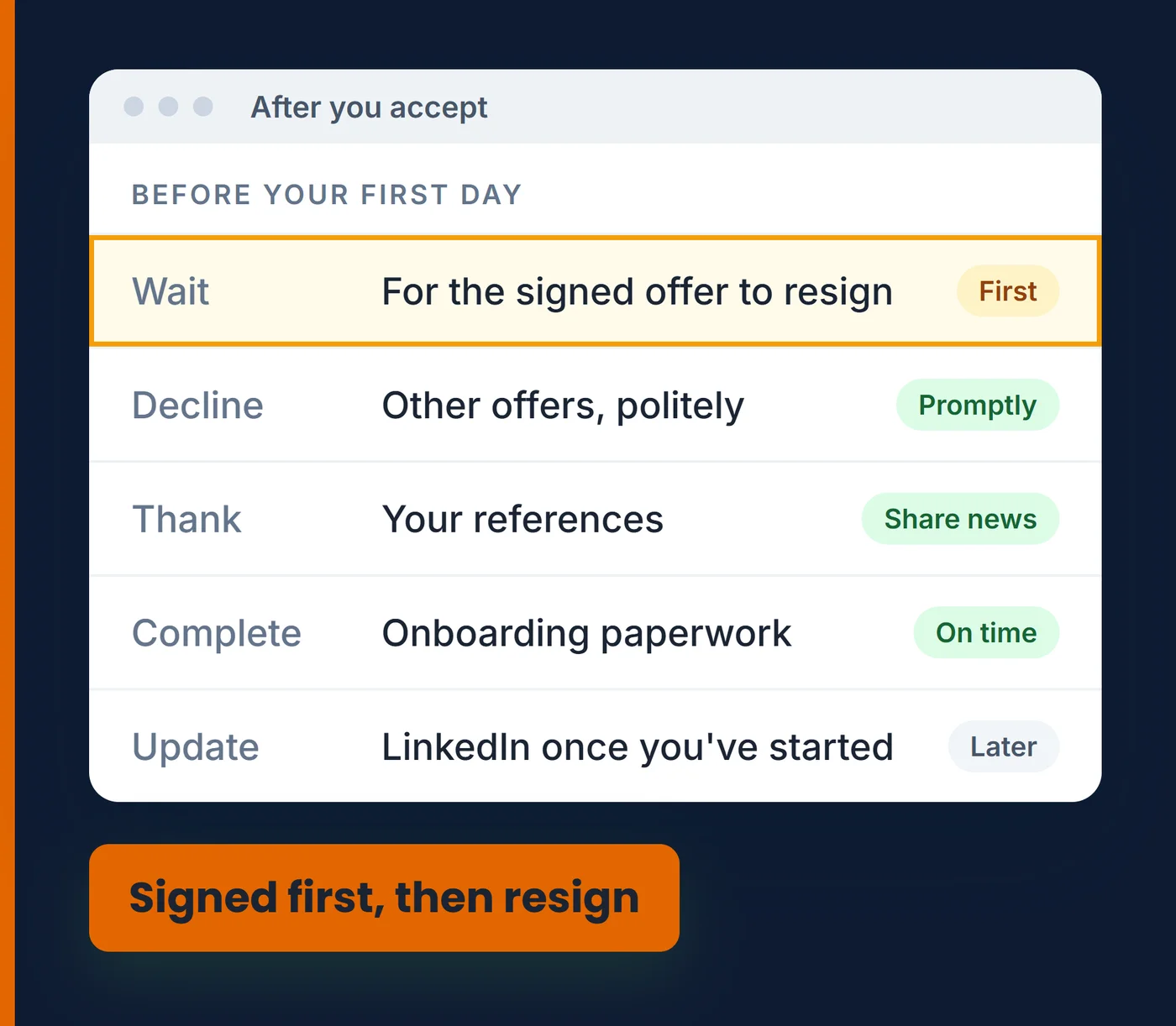
Wait for the signed offer before you resign. Don’t give notice at your current job until you have the final offer in writing and any conditions, such as a background check, have cleared. Then resign professionally and work out your notice period.
Turn down other offers and withdraw other applications. Do it promptly and politely, so other companies can move on to their next candidate. Our guide on how to decline a job offer has email samples for exactly this.
Thank your references. Let the people who vouched for you know you got the job. See how to ask someone to be a reference for more on keeping those relationships strong.
Stay in touch before your start date. Answer onboarding emails quickly, complete paperwork on time, and ask your new manager if there’s anything worth reading before day one.
Update LinkedIn after you start, or once you’ve told your current employer. Announcing a new job before you’ve resigned can cause problems at your current one.
Mistakes to avoid when accepting an offer
- Accepting before you’ve seen it in writing. Verbal details can shift. The written offer is what counts.
- Reopening negotiations after you’ve said yes. It can sour the relationship before you’ve started. Negotiate first, then accept.
- Resigning too early. Wait until the offer is signed and any conditions are cleared.
- Leaving other employers hanging. Every company still considering you deserves a quick, polite note.
- A vague acceptance. “Sounds great!” isn’t an acceptance email. Say you accept and confirm the details.