How to Decline a Job Offer (With Email Samples)
How to decline a job offer gracefully: when to reply, what to say, and email samples for another offer, salary, fit, or after you've already accepted.

Turning down a job offer feels awkward, especially after a company has spent weeks interviewing you. It doesn’t need to be. Declining is a normal part of hiring, and recruiters do it on their side every day. What they remember is how you said no: quickly, politely, and clearly, or after days of silence.
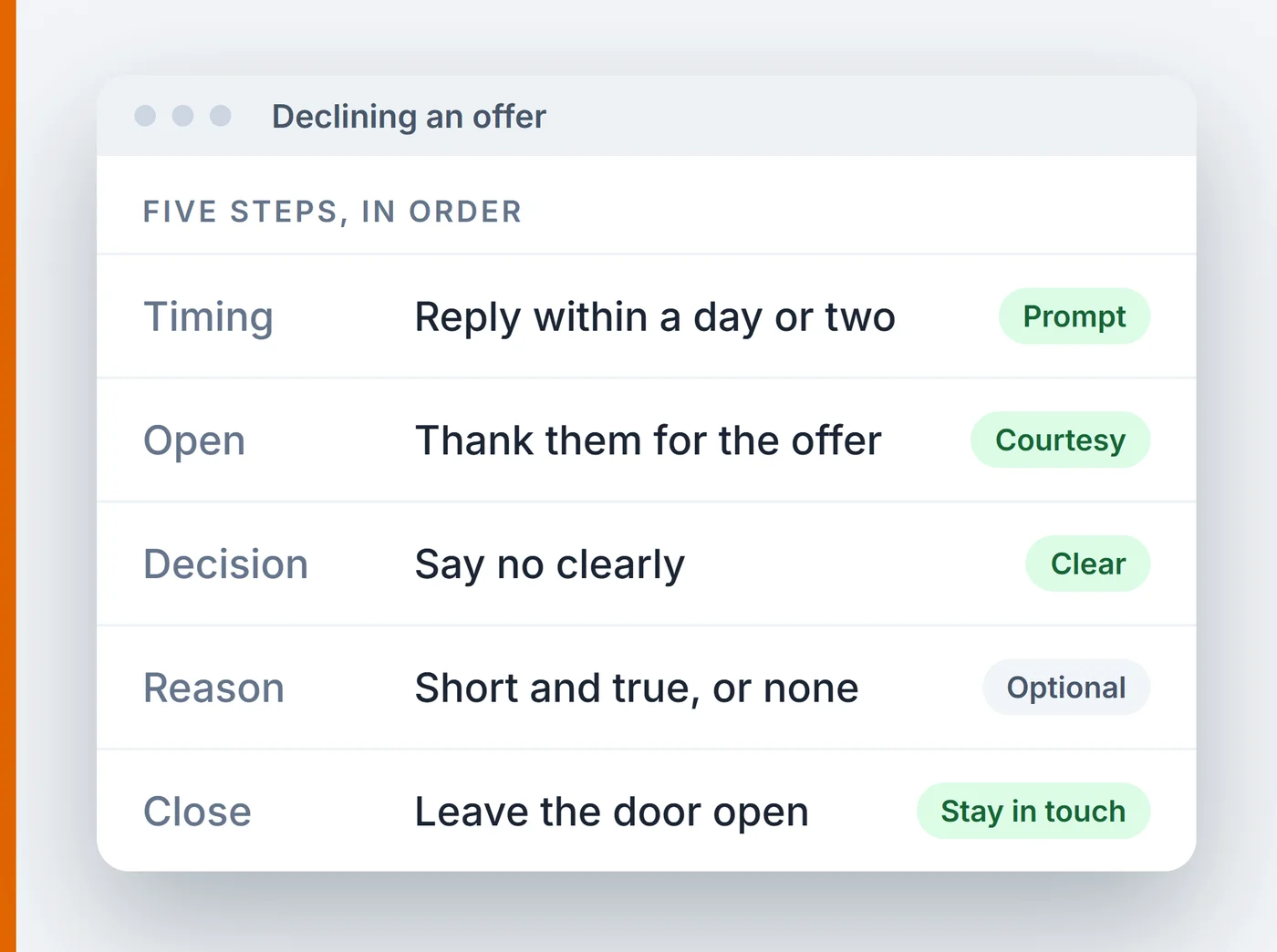
The short version of how to decline a job offer: reply within a day or two, thank them, say no plainly, give a brief reason if you want to, and leave the door open. Below are the steps, a decline job offer email template, and samples for the most common situations.
Before you say no, make sure it’s a no
Some offers are worth one more conversation before you turn them down. If the only problem is the salary, the start date, or another term that could change, ask first. Employers often have more room than the first offer shows, and a polite counter costs you nothing. Our guide on how to counter offer a job has scripts for that conversation.
But don’t negotiate an offer you’ve already decided to refuse. If they meet your number and you still say no, you’ve used up their time and goodwill. Counter only when a better offer would genuinely change your answer.
How to decline a job offer gracefully
Reply quickly. Once you know, tell them. The company may have a second-choice candidate waiting, and every day you hold the offer makes it harder to bring that person back. A day or two is reasonable. A week of silence is not.
Thank them first. Open by thanking them for the offer and the time the team spent with you. It’s courteous, and it sets the tone for everything that follows.
Say no clearly. Use the words “decline” or “not accepting” so there’s no doubt. A vague “I’m not sure it’s the right time” invites a follow-up call to change your mind.
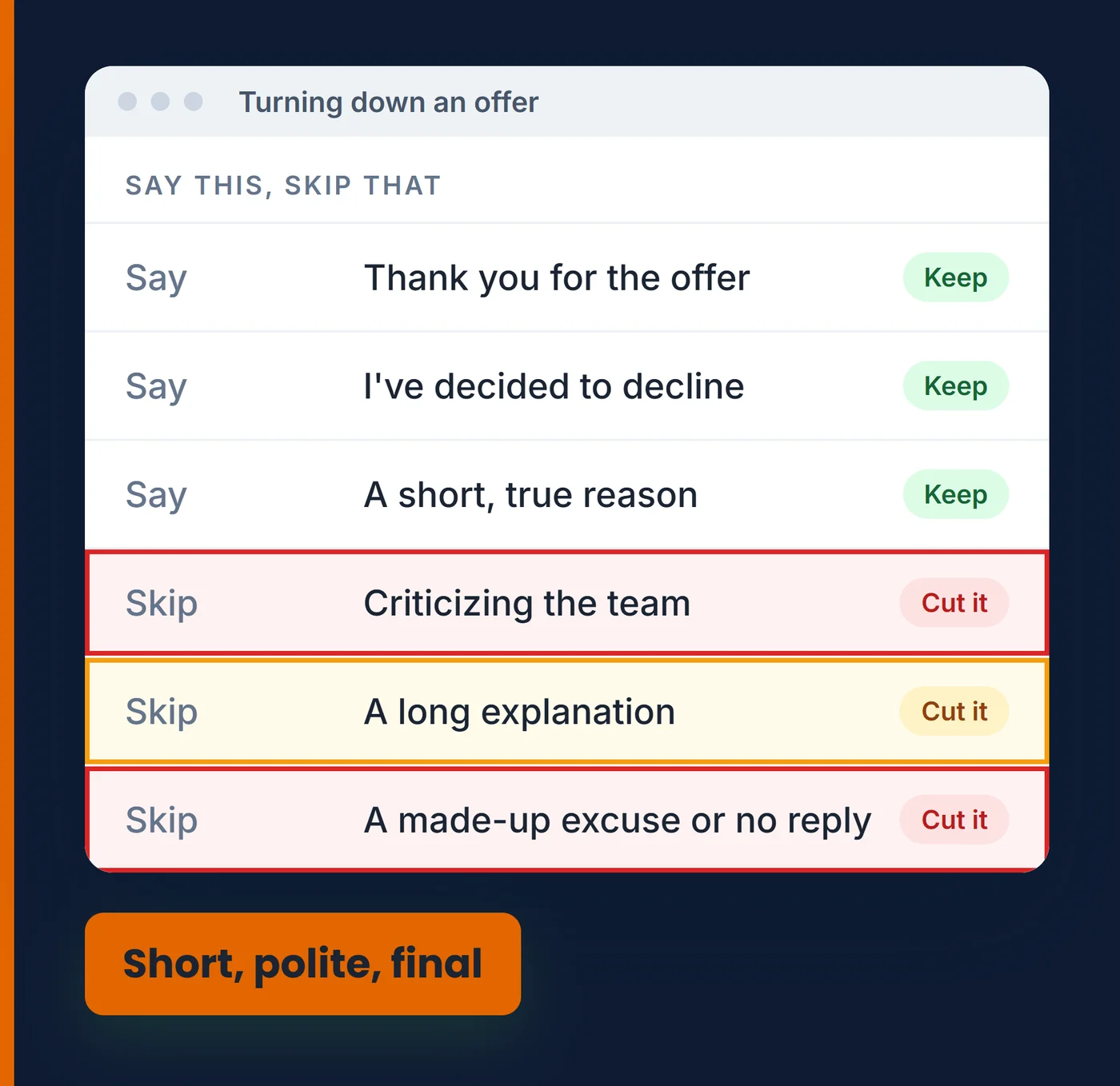
Keep the reason short, or leave it out. You don’t owe a detailed explanation. One honest sentence is plenty: you’ve accepted another role, the salary doesn’t work, or the position isn’t the right fit. Skip anything that criticizes the company, the team, or the process.
Leave the door open. People move between companies, and the hiring manager you turn down today could be the one hiring you in two years. A line about staying in touch keeps that possible.
Decline job offer email template
Email is the usual way to decline, and it gives the employer a written record. If you’ve been dealing with a recruiter by phone, a quick call followed by this email works well too. Reply to the person who made the offer, in the same thread.
Subject: Job offer for [job title]
Hi [Name],
Thank you for offering me the [job title] role, and for the time you and the team spent with me during the interviews. I enjoyed learning about [a project or part of the team’s work].
After a lot of thought, I’ve decided to decline the offer. [One-sentence reason, if you want to give one.]
I appreciate the opportunity and hope our paths cross again. I’d be glad to stay in touch.
Best, [Your name]
That’s the whole email. Short is better here: the longer it gets, the more it reads like an apology or an opening to negotiate.
Sample emails for common situations
Swap one of these into the reason line of the template, or use the full version.
You’ve accepted another offer. This is the most common reason, and the easiest to say. You don’t need to name the other company.
Thank you again for the offer. I’ve accepted a position with another company that’s a closer match for where I want to take my career, so I’m declining your offer. I enjoyed meeting the team and hope we can stay in touch.
The salary doesn’t work. If you’ve already negotiated and the number still falls short, say so without blaming anyone. This keeps the door open if their budget changes.
Thank you for working with me on the offer. After reviewing the final terms, I’ve decided to decline. The compensation doesn’t quite meet what I need at this point, but I appreciated how open you were through the process. If anything changes on your side, I’d be glad to talk again.
The role isn’t the right fit. Keep it about the job, not the people.
Thank you for the offer and for the conversations with the team. After thinking it over, I’ve realized the role isn’t the right fit for what I’m looking for right now, so I’m declining. I have a lot of respect for the work your team is doing and hope we cross paths again.
Personal reasons or timing. You can keep this as private as you like.
Thank you for the offer. Because of a change in my personal circumstances, I’m not able to take on a new role right now, so I need to decline. I’m grateful for your time and would welcome the chance to reconnect in the future.
How to decline after you’ve already accepted
Backing out after you’ve said yes is harder, and it should be rare. The company may have stopped interviewing, turned away other candidates, and started onboarding. If you have to do it, do it as soon as you know, and pick up the phone before you send anything in writing. It’s the kind of news that should come from a voice, not an inbox.
Be direct, apologize once, and don’t over-explain:
I’m calling with news I’m sorry to have to give. After accepting your offer, I’ve had a change [in my circumstances / an opportunity I couldn’t turn down], and I won’t be able to join the team. I know this creates real work for you, and I apologize. I wanted to tell you directly as soon as I knew.
Then follow up with a short email that confirms what you said on the call. Expect that this company may not consider you again, and that the hiring manager may be disappointed. That’s a fair cost of changing your mind late, and the reason to be sure before you accept.
How to decline a job offer over the phone
If the recruiter calls you, or you’d rather say it in person, keep it to a few sentences:
Thank you so much for the offer. I’ve given it a lot of thought, and I’ve decided to decline. [Short reason.] I really enjoyed meeting the team and hope we can stay in touch.
If they ask what it would take to change your mind, you can say honestly that nothing would, or, if a specific change really would, name it. Then send a brief email afterward so there’s a written record.
What not to say when you turn down an offer
- Criticism of the company or the people. “Your interview process was disorganized” won’t help you, and it could reach people you’ll meet again.
- A long justification. The more you explain, the more it sounds like you want to be talked out of it.
- A fake reason. If you make up an excuse, it can come back to you in a small industry. A short true reason, or none, is safer.
- Nothing at all. Ghosting an offer is the one move that reliably burns the bridge.
After you’ve declined
Let anyone who helped you know how it ended: the recruiter who put you forward, the friend who referred you, and the references who took calls for you. A short note is enough, and it keeps those relationships in good shape for the next search.
If you got along with the hiring manager, connect on LinkedIn with a one-line note thanking them again. Our guide on how to network for a job covers how to keep contacts like this going without it feeling forced. The company you turn down this year can become your best lead next time.