How to Follow Up on a Job Application (With Email Samples)
When to follow up on a job application, who to contact, and email and LinkedIn samples for checking your application status without being pushy.

You sent the application, and then nothing. No confirmation beyond an automatic email, no call, no rejection. Most applications go quiet like this, and a well-timed follow-up is one of the few ways to get your name in front of a person instead of a queue.
Here’s how to follow up on a job application: when to do it, who to contact, what to say, and samples for email and LinkedIn you can adapt.
Should you follow up at all?
Usually, yes, as long as you do it once and do it well. A short, polite message shows interest and can prompt someone to look at your application. The exceptions:
- The posting says not to. “No calls or emails, please” means exactly that. Respect it.
- You applied through a huge portal with no named contact. If there’s no recruiter or hiring manager you can identify, a follow-up may simply land nowhere. In that case your time is better spent finding a contact, or on the next application.
- You’ve already been told the timeline. If the posting says interviews start on a certain date, wait until then.
When to follow up on a job application
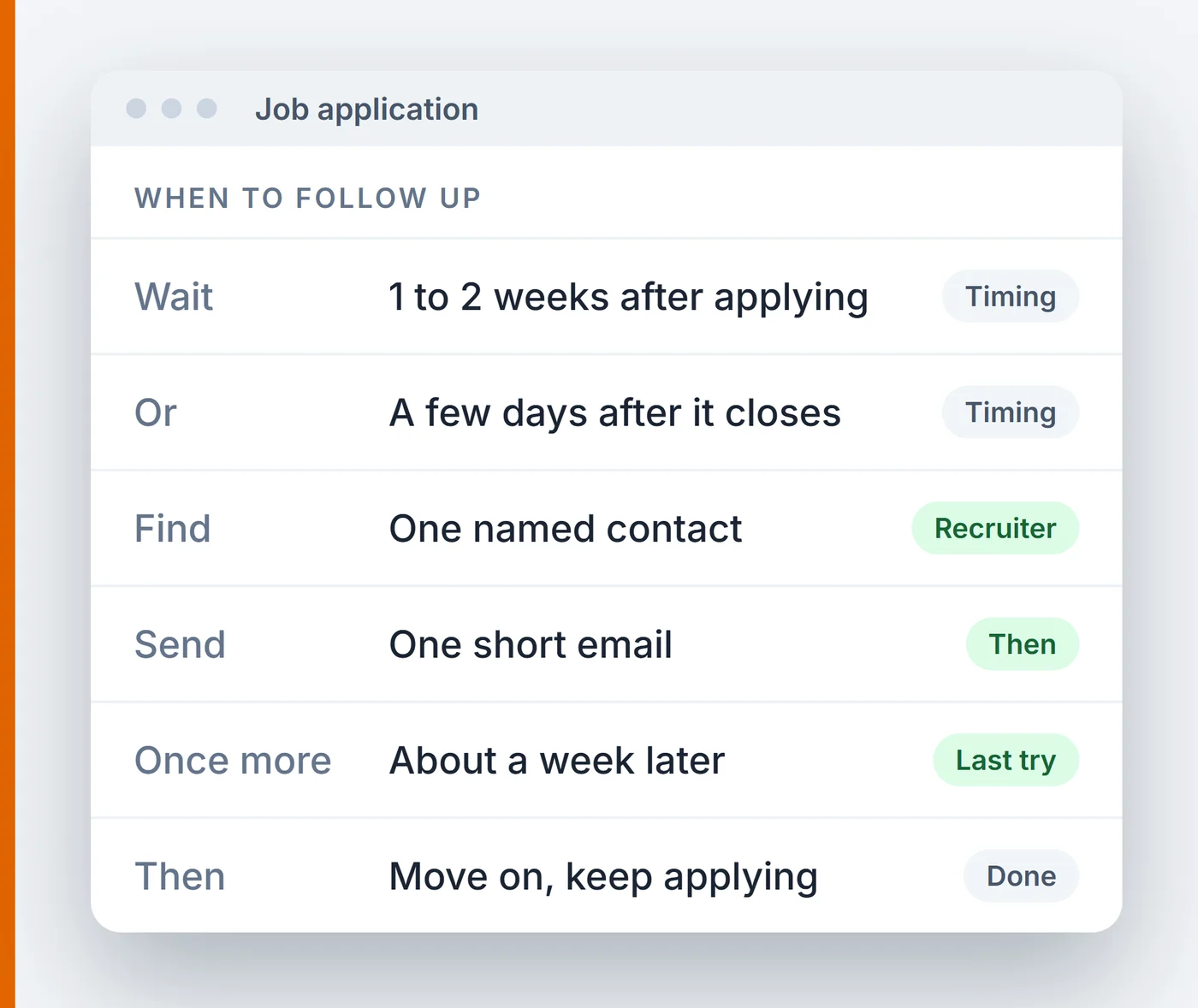
Give it about one to two weeks after you apply. That’s long enough for the team to start reviewing applications, and soon enough that the role probably isn’t filled.
If the posting lists a closing date, wait until a few days after it. Many teams don’t look at applications in detail until the posting closes. Following up before then asks a question they can’t answer yet.
Time it for the start of the working day, Tuesday to Thursday if you can. Messages that arrive late on a Friday are easy to miss.
Who to contact
A follow-up works best when it reaches a person who can act on it. In rough order of preference:
- The recruiter or hiring manager named in the posting, if there is one.
- The person who referred you, if you applied through a referral. Ask them to check on your application, or for the right contact.
- A recruiter at the company on LinkedIn. Search the company’s page for “recruiter” or “talent acquisition,” ideally someone who hires for your type of role.
- The hiring manager for the team, if you can identify them from LinkedIn or the company site.
Pick one person, not five. Messaging several people at the same company in the same week looks like pressure, not interest.
Job application follow-up email template
Keep it short, give them the details they need to find your application, and add one line that makes you worth a second look.
Subject: Following up on my application for [job title]
Hi [Name],
I applied for the [job title] role on [date] and wanted to follow up to say how interested I am in the position. [One sentence connecting your background to the role, for example: “I’ve spent four years running customer onboarding for SaaS products, which lines up closely with the responsibilities in the posting.”]
I’d welcome the chance to talk about how I could help the team. Please let me know if there’s anything else I can send, or if there’s a better person to follow up with.
Thank you for your time, [Your name] | [phone number] | [LinkedIn profile link]
Attach your resume again or include a link to it, so they don’t have to search for your application. Our resume writing guide covers what should be at the top, since that’s what they’ll see first.
Follow-up samples for different situations
A LinkedIn message to a recruiter. LinkedIn connection notes are short, so get straight to it:
Hi [Name], I recently applied for the [job title] role at [Company]. I have [X years] in [field] and was excited to see the opening. I’d appreciate the chance to connect, and I’m happy to share more about my background if it’s useful.
When you were referred. Mention the referral in the first line, because it’s the reason they’ll read on:
Hi [Name], [Referrer’s name] suggested I reach out. I applied for the [job title] role on [date] and wanted to introduce myself. [One line on your fit.] I’d love to talk if you think there’s a match.
After the closing date.
Hi [Name], I applied for the [job title] position before the posting closed on [date] and wanted to check on the status of my application. I’m very interested in the role and happy to provide anything else you need for your review.
A second follow-up, about a week after the first, if you’ve heard nothing:
Hi [Name], I’m following up once more on my application for [job title]. I understand you’re likely reviewing many candidates. If the role is still open, I’d be glad to talk. If it’s been filled, thank you for letting me know, and I’ll keep an eye out for future openings.
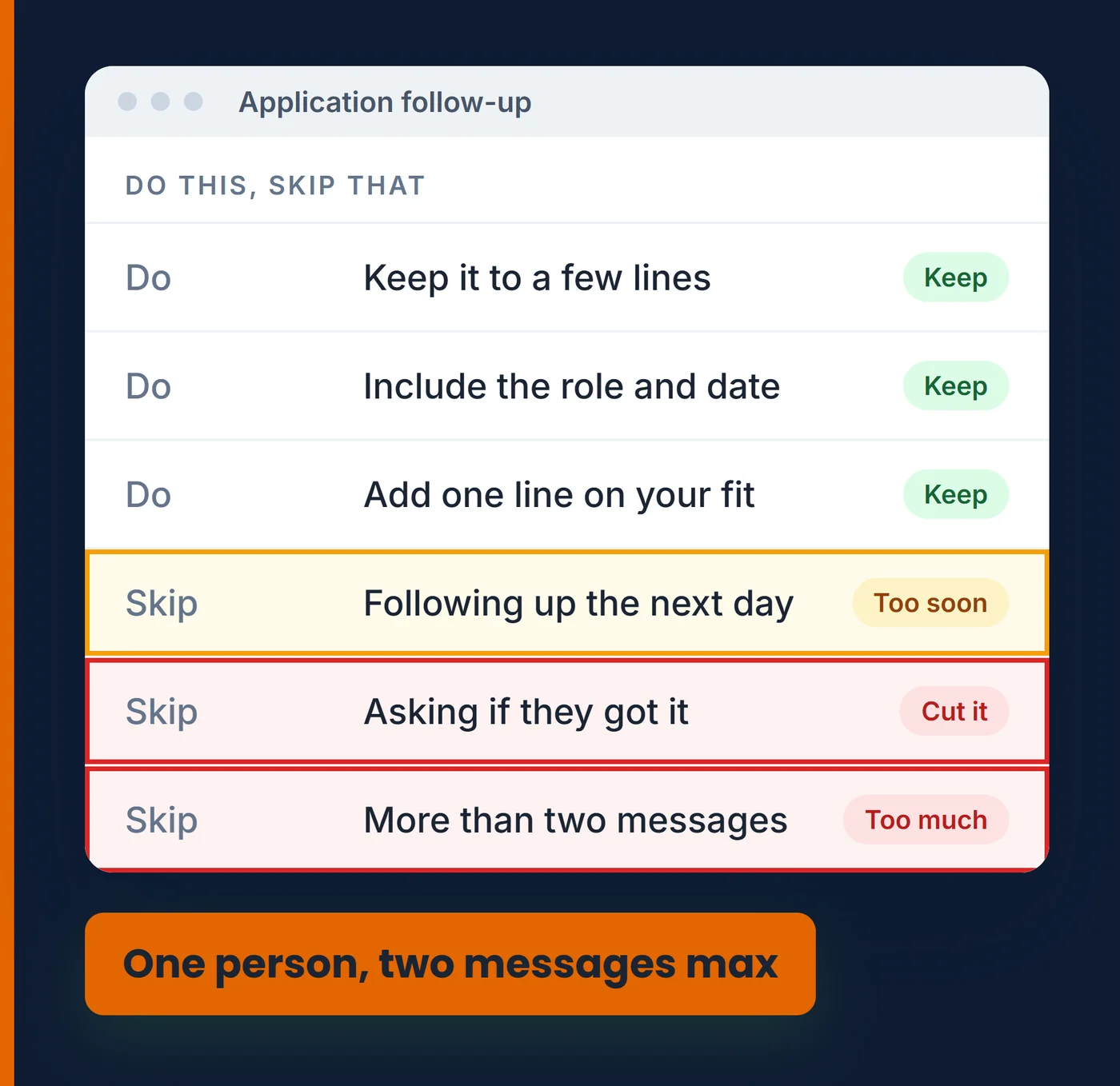
After that, stop. Two messages is enough. More than that hurts more than it helps.
Can you call instead?
Calling is fine for smaller companies, local businesses, and roles where phone skills matter, especially if a phone number is listed in the posting. Keep it to under a minute: your name, the role, the date you applied, one line about your fit, and a question about timing. If you get voicemail, leave the same short message once and follow up by email.
For larger companies, email or LinkedIn is usually the better choice. Recruiters there handle a lot of roles at once and rarely take unscheduled calls.
Mistakes to avoid
- Following up the day after you apply. Nobody has looked yet. Give it time.
- Asking “Did you get my application?” The automatic confirmation already answered that. Ask about the role or timing instead.
- Copying your cover letter. The follow-up should be a few lines, not a second application. Save the detail for your cover letter.
- Sounding entitled or frustrated. “I haven’t heard anything” reads as a complaint. Keep the tone warm.
- Following up on every application. Save the effort for the roles you really want and fit well. A generic follow-up on a long-shot application rarely changes anything.
If you still don’t hear back
Silence after two follow-ups usually means the role has moved on without you, or the process has stalled for reasons that have nothing to do with you. Keep applying elsewhere, and keep the contact: a recruiter you’ve messaged politely may think of you for the next opening.
If your follow-up leads to an interview, see our guides on how to respond to an interview request and how to follow up after an interview for the next steps.