How to Write a Cover Letter That Stands Out
What to put in each part of a cover letter, from greeting to close, with sample opening, achievement, and closing lines you can adapt.

A hiring manager reading your cover letter wants the answer to one question: why you, for this job? Your resume already lists what you’ve done. The letter’s job is to connect a few of those things to what this employer needs, in a page or less, in your own voice.
You aren’t writing an essay. You’re filling in four parts, in order: the greeting, an opening paragraph, a middle where you match yourself to the job, and a close. Here’s what goes in each, with sample lines you can adapt.
Before you write: research the company and the reader
A tailored letter starts with a little homework. Read three things:
- The job posting. Mark the skills and requirements it mentions, especially the ones that come up more than once, and note the exact words it uses for them. You’ll reuse those.
- The company’s website. The About page, the mission or values statement, and any team or careers pages tell you what the company cares about.
- Recent company news. A launch, an expansion, or a new project that relates to the role is worth one sentence in your letter. One is enough.
Then try to find out who will read your letter. The posting sometimes names the hiring manager or recruiter. If it doesn’t, check the company website or search LinkedIn for the person who leads the team you’d join. A name shows you took the time to look.
The greeting
If you found a name, use it:
Dear Ms. Rivera,
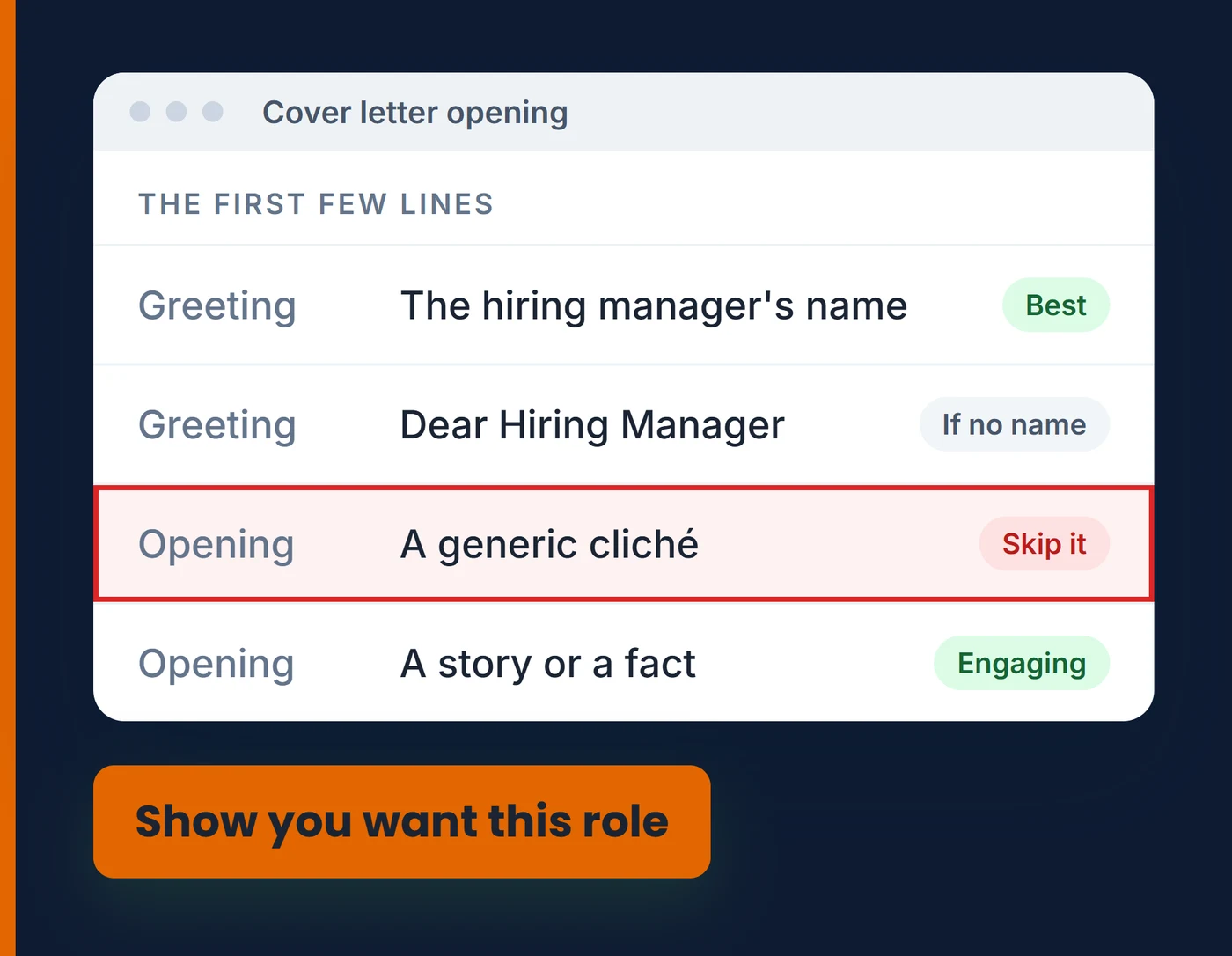
If you aren’t sure which title the person uses, write the full name instead: “Dear Alex Rivera.” If you couldn’t find a name at all, “Dear Hiring Manager” is still appropriate. Skip “To Whom It May Concern,” which reads like a form letter.
The opening paragraph
Your first sentence has to earn the second. Most cover letters open the same way, so the reader has seen this one many times:
Weak:
I am writing to express my interest in the Marketing Coordinator position at [Company].
It tells the reader nothing the subject line didn’t. A stronger opening names the role and gives a reason to keep reading in the same breath:
Stronger:
Your posting asks for a Marketing Coordinator who can run email campaigns from first draft to final report. That has been the core of my job at [Current Company], and I’d like to do the same work for [Company].
Other openings work too: a short story about how you got into the field, a fact about the company’s work that connects to yours, or a plain statement of why this is the role you want. Whichever you choose, skip the generic lines (“I am a hard-working team player with a passion for excellence”) and make it about this job.
Finish the paragraph with a sentence or two on why you want this role at this company, using what you found in your research. Real enthusiasm sounds specific: a product you use, a project they announced, a value from their site that matches how you already work.
The middle: match yourself to the job
This is the core of the letter: usually one or two paragraphs that prove you can do what the posting asks.
Pick the two or three requirements from the posting that matter most for the role. For each one, write a sentence or two with an example from your own experience that shows you meet it. Use the posting’s own words where they honestly describe what you did. Employers often use applicant tracking systems (ATS) to scan applications for specific keywords, and the same language tells a human reader you understand the role.
Quantify what you did. Numbers make a claim believable. Compare:
Weak:
Managed a successful marketing campaign.
Stronger:
Managed a marketing campaign that resulted in a 20% increase in sales within three months.
The second shows how big the result was and how fast it came. If you don’t have exact percentages, use figures you can stand behind: budget, team size, number of clients, turnaround time. Our post on what recruiters look for in a resume has more before-and-after examples.
Add the context your resume can’t. Your resume already lists that campaign. The letter can say what the resume has no room for: the problem you were solving, the hard part, and what changed for the team or the company afterward. One relevant project told in three or four sentences does more than five projects listed in one.
Show you’d fit. Connect the way you work to something the company says it values. A single sentence is enough:
Your site says your team makes decisions from customer data, and that’s how I run every campaign: test small, measure the results, then scale what works.
If the job involves working across departments or with people from different backgrounds, a brief example of doing that well belongs here too.
Gaps, career changes, and red flags
If something in your history might raise a question (a gap, a career change, a short stint at your last job, a requirement you don’t fully meet), address it briefly instead of hoping the reader won’t notice. One or two sentences is enough: what happened, and why you’re ready for this role now.
After two years away from work caring for a family member, I’m returning to accounting full time. I’ve kept my skills current with [course or certification], and I’m ready to get back to month-end close work.
For a career change, lead with the skills that carry over:
After several years teaching high school science, I’m moving into instructional design. I’ve already built [number] online courses for my district, and I’d bring the same focus on what learners actually remember.
If you’re missing a skill the posting asks for, say what you’re doing about it (“I’m currently completing [certification]”). Be honest, keep it short, and don’t apologize. Most of the letter should be about what you can do.
The close
End with three things: a one-line reminder of why you fit, a thank-you, and a clear next step. Here’s a sample closing paragraph:
I’d welcome the chance to talk about how my experience running email campaigns could help [Company] grow its customer list. Thank you for your time and consideration. You can reach me at [phone] or [email], and I look forward to hearing from you.
Sincerely, Jordan Lee
Include your phone number and email even if they’re in your resume header. And ask for the conversation directly. “I’d welcome the chance to talk” is a call to action. “I hope you’ll consider me” is a wish.
Keep it to one page
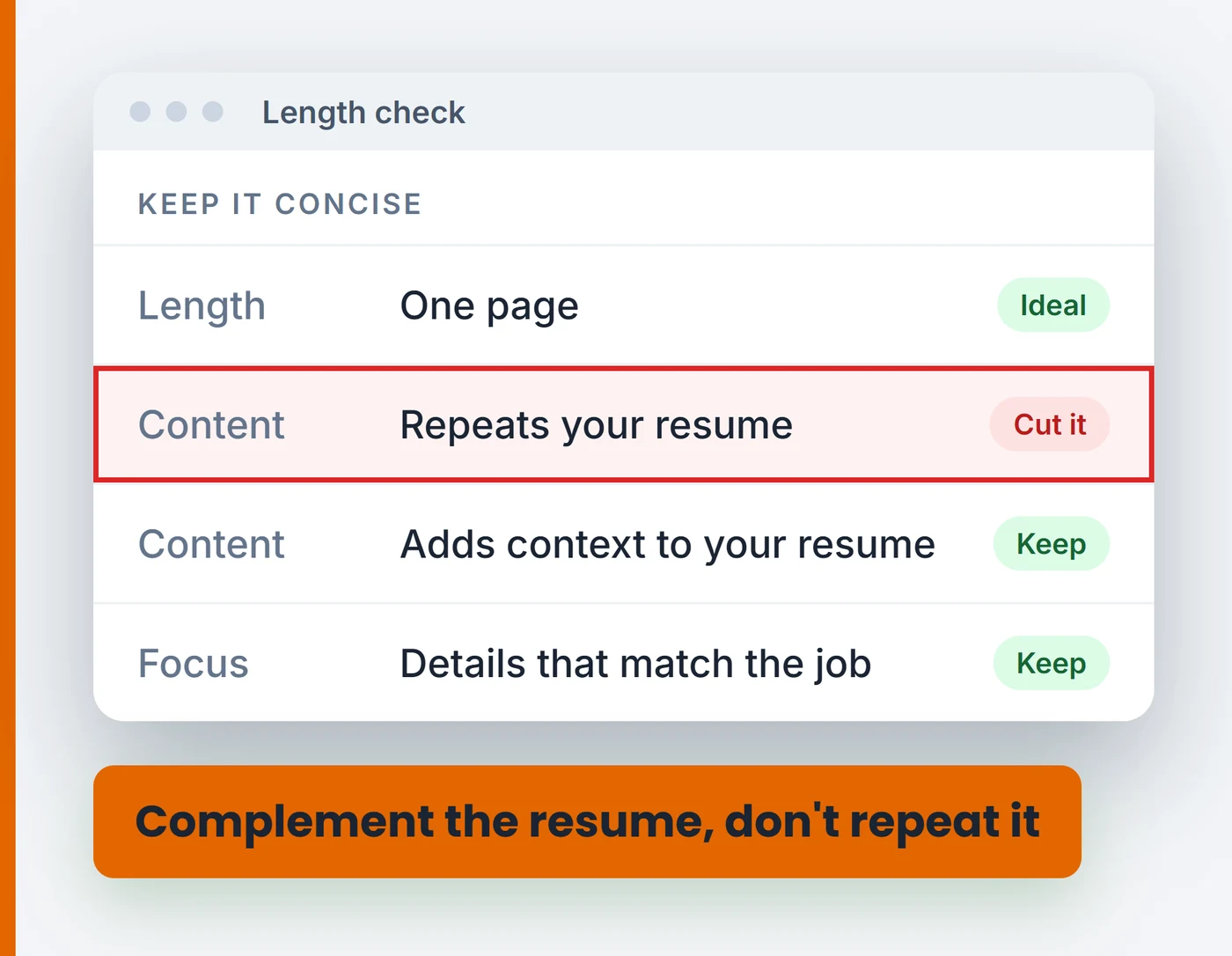
A cover letter should fit on one page, which usually means three to five short paragraphs. Keeping it tight shows you can decide what matters, and it respects the reader’s time.
The easiest way to cut is to look for anything that repeats your resume. The letter should complement the resume, not restate it. Keep the details that add context or match the job, and cut the rest. If you’re still over a page, drop your weakest example rather than shrinking the font or the margins. For the other half of your application, see our resume writing guide.
Read it once more before you send it
Check the tone. A cover letter is a professional document, so keep it formal and respectful. It should still sound like a person wrote it. Leave out slang, and avoid jargon or acronyms the reader might not know. The first person to see your letter may be a recruiter, not a specialist in your field.
Proofread. Read the letter out loud, slowly. You’ll hear missing words and clumsy sentences that your eyes skip over. Then check the details that cause the most damage: the company’s name, the reader’s name and title, and the job title. If you reused an old letter, make sure the previous company’s name is gone.
Get a second reader. Ask a friend or former colleague to read it. They’ll catch mistakes you’ve stopped seeing, and they can tell you whether the opening made them want to keep reading.
When it passes all three, send it in the format the posting asks for. If it doesn’t say, a PDF with your name in the file name is a safe choice.