How to Turn Job Rejections into Opportunities
What to do after a job rejection: send a thank-you note, ask for feedback, find the pattern in your nos, and keep the door open for the next role.

A rejection email usually tells you almost nothing. “We’ve decided to move forward with other candidates” doesn’t say what you did wrong, what the winner had that you didn’t, or whether you came close. But a rejection is still information, and the people who get the most out of a job search are the ones who treat it that way.
What you do in the days after a no can get you feedback, a contact inside the company, and a clearer idea of what to fix before the next application. Here’s how to handle it.
Give yourself a day
Rejection stings, especially for a job you wanted. It’s normal to feel discouraged and to start questioning whether you’re good enough. Those feelings don’t mean you’re handling it badly. They mean you cared about the outcome.
Keep two things in mind. First, rejection is a routine part of every job search, and even very qualified candidates get turned down. Second, a hiring decision is about one role, one set of candidates, and one moment. It isn’t a verdict on your worth or your potential.
So give yourself a day before you reply or rework anything. Then treat yourself the way you’d treat a friend in the same spot. Skip the self-blame (“I always blow interviews”) and ask a more useful question: what can I learn from this one?
Send a thank-you note and stay on their radar
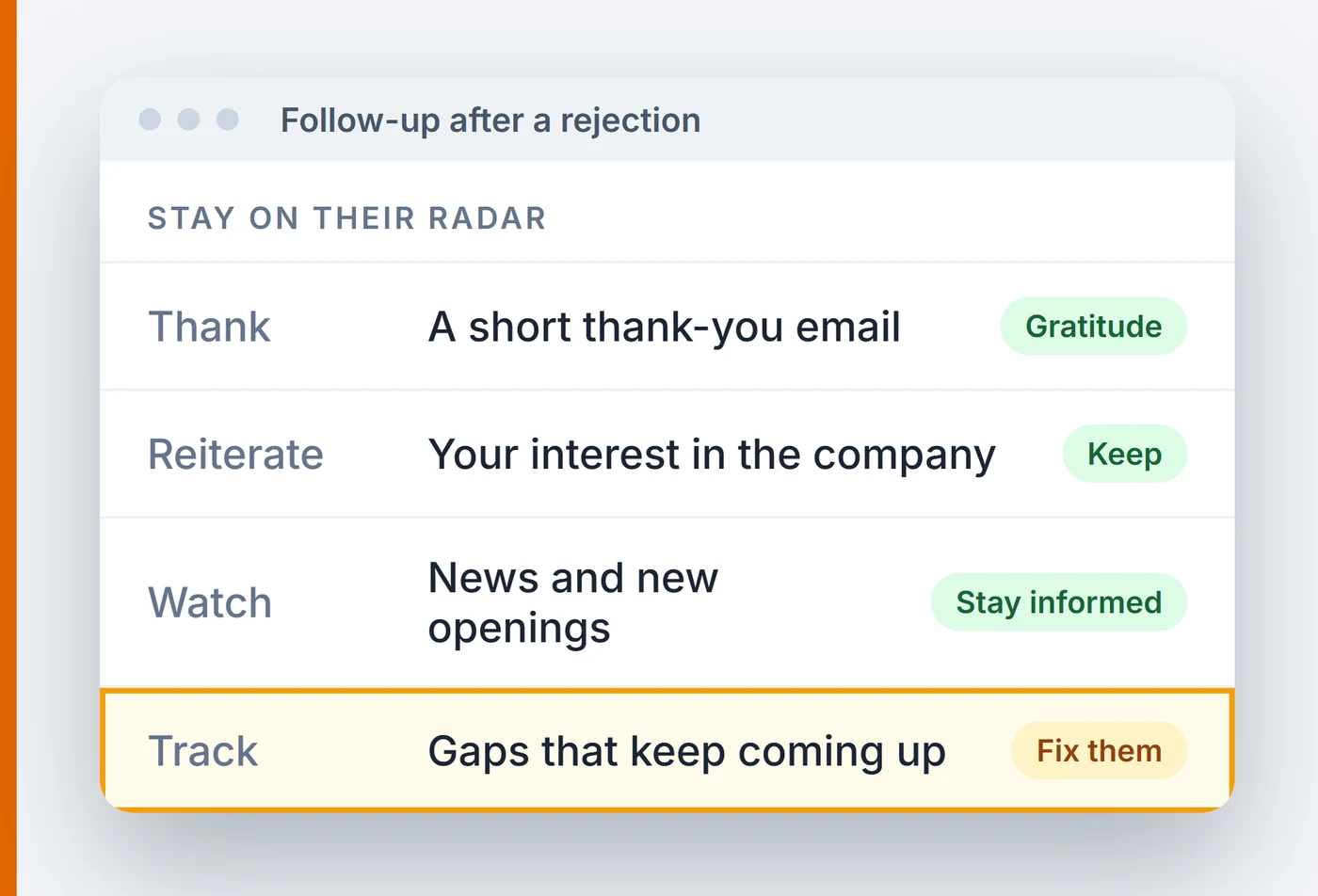
A short, gracious reply to a rejection is rare, which is exactly why it gets noticed. It leaves a good last impression with the hiring manager or recruiter, and it keeps you in mind for future openings or referrals.
Keep it brief. Something like this works:
Hi Jordan,
Thank you for letting me know, and for the time you and the team spent with me. I enjoyed learning about the work your group is doing, and I’m still very interested in the company. If another role opens up that fits my background, I’d love to be considered.
Best, Sam
After that, stay informed. Follow the company’s news, product launches, and new job postings. If a relevant role appears, apply and mention that you interviewed before. Checking in occasionally (every few months, not every week) shows you’re still engaged without becoming a nuisance.
While you’re at it, start a simple log of every rejection: the role, how far you got, and any reason you were given or suspect. A few entries in, you’ll start to see gaps that keep coming up.
Ask for feedback
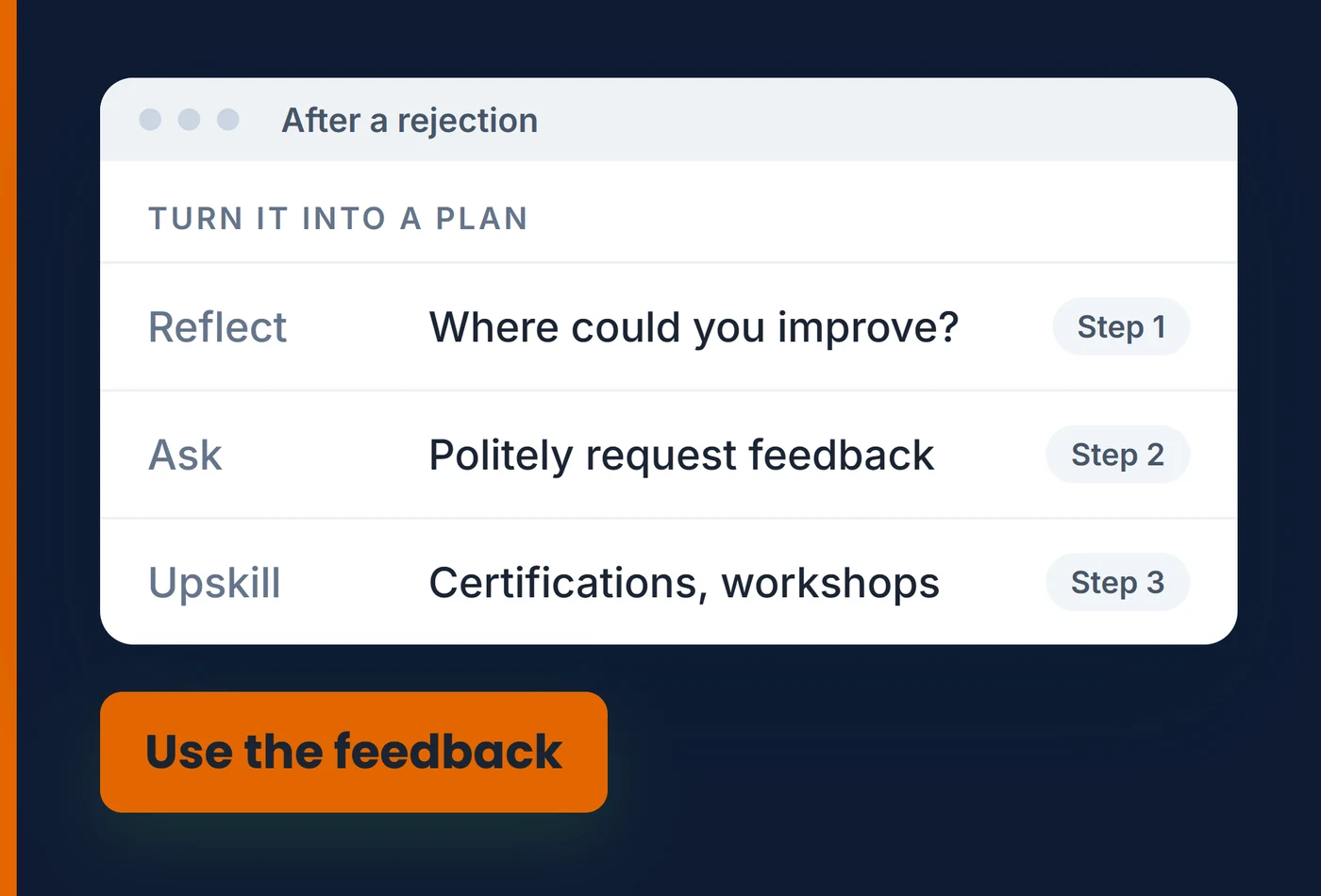
Many employers won’t give feedback, and some have policies against it. It’s still worth asking, politely and once. The worst outcome is silence.
You get better answers with a specific, easy question than with an open-ended one. Compare these:
- “Do you have any feedback for me?”
- “Is there one area where the candidate you chose was stronger than me?”
The second is easier to answer honestly and quickly. You can add it to your thank-you note or send it separately:
If you have a minute, I’d really value any feedback on my application or interview. Was there one area where I could have been a stronger fit for this role?
Whatever comes back, say thank you and don’t argue with it. Even feedback you disagree with tells you how you came across to someone making a hiring decision.
Find the pattern
If no feedback arrives, you can still work out a lot on your own. Treat it as a review, not a self-criticism exercise.
Reread the job posting. Put the requirements next to your resume and be honest about the match. Were there must-have skills or qualifications you didn’t clearly show?
Review your materials. Did your resume and cover letter speak to this specific role, or were they the same versions you send everywhere?
Replay the interview. Which questions did you answer well? Which ones did you ramble through or wish you could redo?
Ask someone you trust. A mentor, a former manager, or a peer in your field can often see what you can’t. Show them the posting and your application, and ask what they’d change.
One rejection can come down to luck or timing. The same weakness across several is a pattern. If, for example, communication keeps coming up, that’s a clear signal about where to put your effort.
Close the gaps you find
Once you know what’s holding you back, fix the specific thing.
If it’s a skill gap, look at the roles you’ve applied for and the skills they keep asking for. That could be a technical skill, industry knowledge, or a soft skill like presenting. Then pick the most direct way to build it: a certification, a workshop, a webinar, a course, or in some cases a degree. Online platforms such as Coursera, Udemy, and LinkedIn Learning make this easier to fit around a job search. A class or workshop on communication, for instance, is a direct answer to feedback that your communication needs work.
If it’s your application, tailor it. Make sure your resume and cover letter match the requirements and values of each job, and lead with the skills, experience, and results most relevant to that role. A tailored application shows you understand what the employer needs.
Ongoing learning also gives you something concrete to say in your next interview: “Since then, I’ve completed a course in X” is a much better answer than a vague promise to improve.
Widen your network
A rejection is a good prompt to spend less time on cold applications and more time talking to people. Conversations lead to job leads and referrals that never show up on a job board.
A few places to start:
- Industry events and conferences, in person or virtual, where you can meet people in your field.
- Professional associations and online communities for your industry. Sharing experiences with people in the same search makes it less isolating, and members often pass along openings.
- Mentors. Look for people who’ve built the kind of career you want and ask for a short conversation about how they got there, including how they handled setbacks.
- Career coaches or counselors. They can help with your resume, interview preparation, and search strategy, and they can be a steady source of encouragement when the nos pile up.
Focus on real relationships, not collecting contacts. Show genuine interest, ask good questions, and offer help where you can. The people who know and trust you are the ones who’ll think of you when a role opens up.
Consider other paths
Sometimes a string of rejections is a sign to look sideways, not just try harder. Take stock of your interests, values, and transferable skills, and research roles and industries where they’d fit. You may find a path you hadn’t considered that suits you better than the one you were chasing.
Two options are worth a look while you search:
Freelancing. If you have skills people will pay for, freelance projects keep you working, build a portfolio, and give you fresh results to show employers. For some people it becomes a career of its own, or a first step toward starting a business.
Volunteering and pro bono work. Offering your skills to an organization whose cause you care about gets you real experience, new contacts, and something current to talk about in interviews. Organizations also notice people who show that kind of commitment, and that can lead to paid work.
If a string of rejections has you rethinking your field altogether, it can help to look at where hiring holds steady. Our guide to recession-proof industries covers which sectors kept adding jobs through the last major downturn. If you’re over 50, see our advice on job searching after 50.
Keep your momentum
A job search is long, and you can’t control whether any single application works out. What you can control is the effort you put in, so set goals around that.
Break the search into small, realistic targets: a number of tailored applications per week, a set number of networking conversations, one course module finished. Hitting those gives you a sense of progress even when the replies are slow.
Count the small wins too. Every application sent, interview attended, and skill learned is progress, and a reward or a night off after a hard week is part of staying in the game.
Each rejection you learn from makes the next application stronger. Read the email, take your day, send the note, ask your question, and then get back to work on the next one.